27.9.05

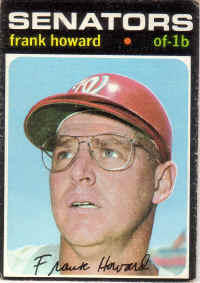
Frank Howard

I'm sure Frank Howard was a very fun player to watch. He was a giant (6'7", 255 lbs) with a mighty swing that produced a lot of homers and a lot a spectacular strikeouts. Despite his size and his lack of speed, he spent the vast majority of his career in the outfield. Watching this hulking man chasing fly balls and line drives had to be entertaining.

Howard came up with the Dodgers was the rookie of the year in 1960, batting .268 with 23 homers and 108 strikeouts in 117 games. He continued along these lines for a couple of years. In 1964, he hit a paltry .226 and whiffed 113 times, but he showed better plate discipline by drawing 51 walks. In the offseason, the Dodgers traded him to the Washington Senators.
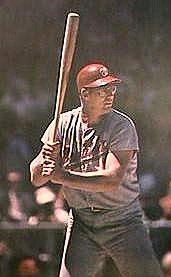
The big guy really blossomed after that, though he never did curtail his strikeouts. In 1968, the year of the pitcher, he belted 44 homers to lead the American League. He had a monster season in 1969, batting .296 with 48 homers. For the first time in his career, he piled up more walks than strikeouts (102 to 96). His OBP for the year was .402. 1970 was eerie similar. He batted .283 with 44 homers. Once again, he piled up more walks than strikeouts (132 to 125). His OBP for the year was .416.

25.9.05

Ken Phelps

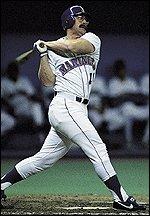
Ken Phelps was slow, had no defensive value and didn’t hit for average. But he had two very valuable tools: power and the ability to get on base. He was a very selective hitter who walked a lot, so he was a good OBP guy (.374 for his career) despite a low career batting average (.239). His patient approach also produced a lot of strikeouts and a lot of homers. During his career, he slugged .480 and averaged 26 home runs per 162 games.

Hitters like that are always underrated because they have a low batting average and they look bad striking out one hundred times a year. The funny-looking glasses certainly didn't help Phelps either. As a result, he had to wait a long time to get regular playing time in the Majors. Originally drafted by the Royals, Phelps was traded to the Expos after two shorts stints with Kansas City in 80 and 81. He responded to the trade by hitting 46 homers at the AA level in 1982. But the Expos didn’t think they had room for him. Before the start of the season, the Expos had addressed their need for a left-handed slugging first baseman (which is exactly what Ken Phelps was) by trading third baseman Larry Parrish to the Rangers to get the aging Al Oliver.

Phelps was sold to the Mariners before the start of the 1983 season. For the Expos, he was a missed opportunity. I’m pretty sure they could have plugged him into their lineup as early as 1983 and get good production for next to nothing, freeing up money to address other needs.

With the Mariners, Phelps didn't play right away either. Despite hitting 24 homers in 290 at-bats in 1984, he didn’t play much the next year. But in 1986, at age 31, Phelps played 125 games and did very well despite batting just .247. He hit 24 homers and walked 88 times, posting a .406 OBP and a .526 slugging average. In 1987, he played 120 games and did even better: 27 homers, 80 walks, .410 OBP, .548 SLG.

In 1988, he was traded to the Yankees during the season (for young prospect Jay Buhner) but posted similar numbers: 24 homers, 70 walks, .402 OBP, .549 SLG. He declined rapidly after that, something the Yankees should have anticipated considering his age. It’s just too bad he had such a late start.

Bob Watson

"Park effect" can really distort the perception of a hitter, for the better or for the worse. Bob Watson is a great example of this. Watson spent his first 13 seasons with the Houston Astros, from 1966 to 1978. During that period, the Astros played their home games at the Astrodome, a very tough park for hitters. His production really suffered because of this. As Bill James notes in the New Bill James Historical Baseball Abstract, Watson has the same number of career home runs on the road as Ted Kluszewski (117). At home, though, Kluszewski holds a 162 to 67 advantage.

I don't think Watson wore glasses on the field at the start of his career. But I know he did wear them on May 12th 1974 in Cincinnati. Playing left field, Watson crashed head-first into the outfield wall and shattered his glasses. As he lay on the ground, Reds fans bombarded him with cups, beer and insults.

In 1979, the Astros traded Watson to the Red Sox. Watson immediately took advantage of his new surrounding, blasting 13 homers in 84 games for the Sox. In 1980, Watson played his last productive season with the Yankees and hit 16 homers. He became a part-time player after that and retired as an Atlanta Brave in 1984. During his career, he played 1088 games at first base, 570 in the outfield and 54 as a DH. He’s a career.295 hitter with a .364 OBP. He scored the 1,000,000th run in major league history in 1975.

24.9.05

Jim Konstanty

Journeyman pitcher Jim Konstanty had a magical season for the Philadelphia Phillies in 1950. The righthander pitched 152 innings in 74 relief appearances, a record number at the time. Posting a 2.66 ERA, he led the league in saves with 22 and notched 16 wins. The Phillies won the NL pennant and Konstanty became the first bespectacled player to be selected league MVP. He probably didn’t deserve the trophy. I don’t even think he was the most valuable pitcher with the Phillies since Robin Roberts pitched 304 innings that season and went 20-11 with a 3.02 ERA.

One thing is certain: Konstanty was not overpowering. In 152 innings, he struck out just 56 batters and walked 50 guys. This is not a good ratio. Apparently, he had a very good palm ball. He probably got a lot of groundball outs with that pitch.

Konstanty pitched exclusively out of the bullpen during the season, but he was a surprise starter for he Phillies in game one of the World Series against the Yankees. He pitched 8 strong innings, giving up one run on 4 hits and 4 walks. But Vic Rashi was even better and the Yankees won 1-0. Third baseman Bobby Brown scored the only run of the game in the 4th inning. He doubled, advanced to third on a fly ball and scored on a sac fly by Jerry Coleman. The Yankees went on to sweep the series in 4 games.

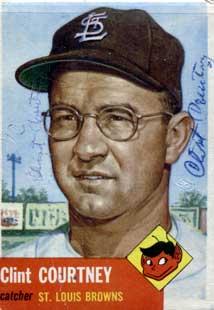
Clint Courtney

During his career, catcher Clint Courtney was known as a very intense competitor and a brawler. Well, he had a good reason to be in a bad mood. He played most of his career with really bad teams and lost a staggering number of games.

Courtney started his career by playing just one game with the 1951 Yankees, a team that went 98-56 and won the World Series. In the offseason, he was traded to the lowly Saint-Louis Browns. With the Browns, he had the chance to play regularly… and to lose regularly. In 1952, the Browns finished 64-90. In 1953, they sinked to 54-100. In 1954, the team became the Baltimore Orioles... but ended up 54-100 once again.

During the winter, the Orioles traded Courtney to the White Sox, a much better team at the time. But the bespectacled catcher played just 19 games for Chicago and then was traded to the Washington Senators, another perennial bad team. The White Sox finished the 1955 season 91-63. Courtney and the Senators ended up 53-101.

Courtney played for the Senators from 1956 to 1959, suffering through 59-95, 55-99, 61-93 and 61-93 seasons. The deliverance came in 1960. Traded to the Orioles just before the start of the season, Courtney played 83 games as a backup catcher and pinch hitter. The Orioles finished 89-65. Finally, he was a winner. During the off season, the Orioles traded him to Kansas City A’s, yet another perennial losing team. The A’s went 61-100 in 1961, but Courtney didn’t have to live through that. He played just one game for the A’s and then was sent back to Baltimore. He didn’t play much for the Orioles, was released in July and retired. The Orioles finished the season 95-67.

Courtney wasn’t a bad player. He’s a career .268 hitter with a .339 OBP, just about league average for his era. Being a lefthanded hitting catcher, he was a useful platoon player. In 1960, he was the first catcher to use an oversized mitt to catch a knuckleballer, the great Hoyt Wilhelm.

20.9.05

Claude Raymond and Eric Gagné

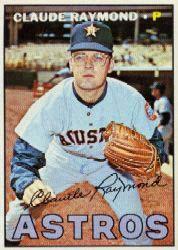
I have to talk about those two guys because they’re both from Quebec, just as I am, and because of their similarity. Claude Raymond was a bespectacled reliever with a bulldog attitude and so is Eric Gagné. They’re clearly the two best Quebec-born ballplayers ever.

Of course, Raymond was not as good Gagné. But he pitched for twelve years in the Majors, logging a very respectable 3.66 ERA and 83 career saves. He made the All-Star team as a Houston Astros in 1966. The most memorable moment of his career occured on May 16th 1969, when he pitched for the first time against the Expos in Montreal as an Atlanta Brave. He came in relief with two men on in the bottom of the ninth The crowd gave him a tremendous ovation and he started to cry on the mound. But he pulled himself together and got out of the inning. The Braves won the game in the 12th inning and he was the winning pitcher.

The Braves traded Raymond to the Expos later that year. In 1970, he had a Field of Dream season with his hometown team. At age 33, he pitched 83 ½ innings, won 7 games and notched 23 saves, a very good total at the time. He retired in 1971 and was a Expos broadcaster for a long time after that. He's moderatly famous for having his fly open on his 1967 baseball card (shown above).

Eric Gagné is one of the most overpowering closer ever. He’s a big guy with three nasty pitches (fastball, curve, change-up), which is a luxury for a relief pitcher. He won the National League Cy Young Award in 2003, logging 55 saves and 137 strikeouts in 82 1/3 innings, with an 1.20 ERA . But he’ll never pitch for the Expos in Montreal...

19.9.05

Mole verde express

Le mole verde est une sauce verte à base de tomatilles dont on peut se servir pour faire mijoter au four du poulet et du porc. Pour réaliser une version express de cette délicieuse recette, vous besoin de trois choses:

1. Un paquet de morceaux de poulet. Moi, je prends des hauts de cuisse dessosés sans peau, mais des pilons ou des cuisses entières font aussi l'affaire.
2. Un paquet de trois ou quatre côtelettes de porc.
3. Un pot de 16 onzes de "salsa verte" Herdez. Cette sauce ressemble à s'y méprendre au mole verde qu'on fait soi-même en suivant une recette mexicaine.

Placez le poulet et le porc dans un plat allant au four et de balancer là-dessus tout le pot de salsa verte. Couvrez et mettez au four à 300 pour au moins deux heures. Il faut cuire jusqu'à ce que la viande soit très tendre et se défasse facilement à la fourchette. Si la sauce est trop claire en fin de cuisson, retirez le couvercle et laissez cuire encore quelques minutes. Servez avec de la purée de haricot.

Bespectacled pioneers

All right, you can’t compare these guys with Jackie Robinson. But they were pioneers just like him and they deserve some recognition.

The first player to wear glasses in the Majors was pitcher Will White. From 1877 to 1886, he won 229 games in the National League and American Association , posting a 2.28 career ERA. He was a curveball pitcher.

Baseball glasses barrier was broken again in april 1915, when pitcher Lee Meadows and became the first bespectacled player of the 20th century. Meadows was a sidearmer with a spitball. He went 188-180 in 15 seasons with the Cards, Phillies and Pirates. He started for the Pirates in the first game of the World Series in 1925 and 1927, losing both times. Another bespectacled pitcher, Carmen Hill, started his big league career with the Pirates in august 1951. Hill pitched 10 years in the Majors, mostly as a reliever, going 49-33. He went 22-11 an 16-10 as a starter for the Pirates in 1927 and 1928. Lee Meadows and Carmen Hill played together for the Pirates from 1926 to 1929.

In 1921, George "Specs" Toporcer became the first position player to wear glasses on the field. He played 8 seasons with the Saint-Louis Cardinals as a utility man, posting a .279 career average. He lost his eyesight in 1951 while managing in the International League.

In 1951, Clint Courtney became the first bespectacled catcher with the Yankees. He played just one game for the Yankees but stayed in the Majors for 11 seasons, playing for the Saint-Louis Browns, Baltimore Orioles, Chicago White Sox, Washington Senators and Kansas City Athletics. He’s a career .268 hitter.

18.9.05

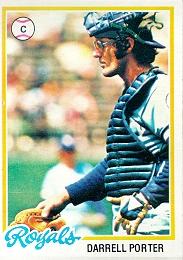
Darrell Porter

Darrell Porter is almost exclusively remembered for his post-season performance in 1982 with the Cardinals. That year, the bespectacled catcher was named MVP of both the National League championship series and the World Series. He was particularly spectacular in the championship series, batting .556 with 5 walks (for a .714 OBP) and three doubles, as the Cards swept the Braves in three games.

During his career, Porter got a lot of attention because he publicly stated that he was a recovered alcoholic and talked about his faith in God. The focus should have been on his play in the field.

Drafted fourth overall by the Brewers in 1970, Porter had great career. He was a superb defensive catcher and an underrated hitter because of his low batting average. He batted .247 in 17 seasons in the Majors… but his career OBP stands at .354 because he walked a lot. And he had good power for a catcher, averaging 17 homers by 162 games. He had an amazing season with the Royals in 1979, hitting .291 with 20 homers, 121 walks and 112 RBI. His OBP for the year was .421 and he slugged .484. In The New Bill James Historical Abstract, Bill James rates him as the 18th best catcher of all time.

Kent Tekulve

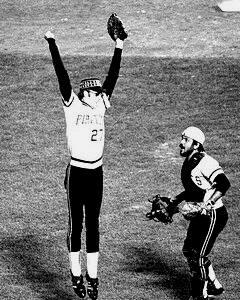
In 1978, Kent Tekulve took over as the Pirates ace reliever after Goose Goosage signed with the Yankees. You’d be hard pressed to find two more different righthanded pitchers Goosage was a big guy with a great fast fastball, an intimidating figure on the mound. Tekulve was an tall but amazingly thin, a submariner who wore glasses and looked completely out of place on a baseball diamond. But he was just as good as Goosage, thank to his funky delivery and his pinpoint control.

I always like unusual pitchers, so I was a big Kent Tekulve fan as a kid. Even now, I still have fun imitating his delivery while I’m warming up before playing softball. For me, he’s still the ultimate submariner.

Tekulve and Goosage were not closer in the modern sense of the term. They didn’t pitch only in the ninth innings and in save situations. They were reliever who pitched in close games, often for two or three innings. They were much more useful to their team than the prototypal modern closer simply because they pitched far more innings. Maximizing the number of saves was not the priority. In 1978 and 1979, Tekulve pitched 135 innings for the Pirates but notched "only" 31 saves both years.

This was perfectly exemplified in the 1979 Word Series that the Pirates won over the Orioles. In the seven games series, Tekulve pitched five times, logged 9 1/3 innings and saved three games. In game 1, he pitched one inning in to save a 3-2 win. In game 3, he pitched two scoreless innings (the 8th and 9th) in an 8-4 loss. In game 4, the Pirates held a 6-3 lead when he entered the game in the 8th inning with the bases loaded and one out. The Orioles ended up scoring six runs against him to win the game 9-6. Tekulve was the losing pitcher. In game 6, he pitched the last three innings in 4-0 win to notch his second saves of the series. And in game 7, he took the mound in the 8th with two runners base to protect a 2-1 lead. He got out of the jam and pitched a perfect nine to get his third saves a World Series ring. Now, that's managing an ace reliever as far as I' concerned.